Understanding variable scope in Python is essential to avoid errors and write more predictable programs. Scope defines where a variable can be accessed and modified. To understand it in depth, I will explore three fundamental concepts: Local Scope, Enclosing Scope, and Scope Precedence.
What Is Variable Scope in Python?
In Python, variables have different reaches (or scopes) depending on where they are defined. This determines where they can be used in the program. The main types of scope in Python are:
- Local Scope
- Enclosing Scope
- Global Scope
- Built-in Scope
The focus here is to understand the first three and how the precedence between them affects the program’s behavior. For an official reference, see the Python documentation on namespaces and scopes.
Local Scope: The Narrowest Scope
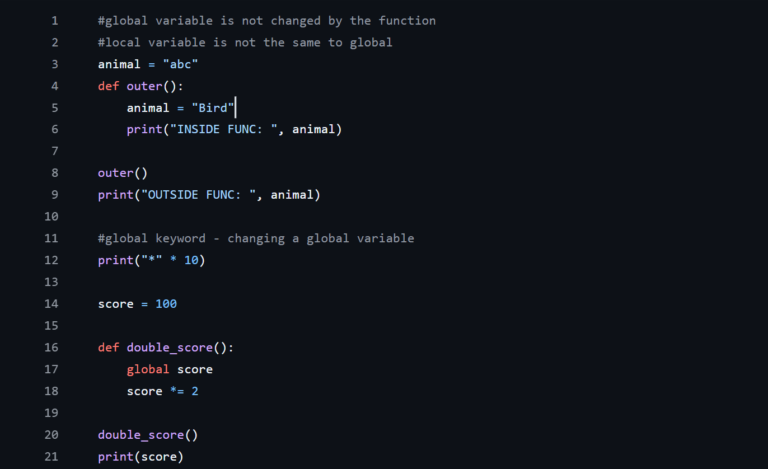
Local scope refers to variables defined inside a function. They are accessible only within that block and stop existing as soon as the function finishes running. This is the most common scope when it comes to variable scope in Python.
If a variable is defined inside a function, it cannot be accessed outside of it, which prevents conflicts and keeps the code modular.
Local Scope Example:
def calculate_square(number):
    result = number ** 2  # Local variable
    return result

print(calculate_square(4))  # Output: 16
print(result)  # Error: result is not defined in the global scope
Enclosing Scope: The Scope of Nested Functions
Enclosing scope occurs when one function is inside another. The inner function can access the outer function’s variables, but it cannot modify them without the nonlocal keyword.
This concept is important when it comes to variable scope in Python, because it lets nested functions share data without resorting to global variables.
Enclosing Scope Example:
def greeting():
    text = "Hello"

    def add_name(name):
        return f"{text}, {name}!"  # Accesses 'text' from the outer function

    return add_name("Carlos")

print(greeting())  # Output: Hello, Carlos!
Scope Precedence: The Lookup Order for Variable Scope in Python
Python follows the LEGB rule to determine which value to use when a variable is referenced:
- Local (L): First, it looks in the current function’s scope.
- Enclosing (E): Then, it checks the enclosing scope (outer function).
- Global (G): Next, it checks global variables.
- Built-in (B): Finally, it examines Python’s built-in scope.
If there are variables with the same name in different scopes, Python follows this order to decide which one to use. Learn more about how variables and scopes behave in the official Python documentation.
Scope Precedence Example:
message = "global"

def outer():
    message = "enclosing"

    def inner():
        message = "local"
        print(message)  # Which message will be printed?

    inner()

outer()  # Output: "local"
Complete Example: Different Scopes in Action
Here is an example that demonstrates variable scope in Python, including local, enclosing, and global scope in the same code:
global_value = "Global variable"

def outer():
    outer_value = "Variable in the enclosing scope"

    def inner():
        local_value = "Local variable"
        print(local_value)  # Accesses the local variable
        print(outer_value)  # Accesses the enclosing scope variable
        print(global_value)  # Accesses the global variable

    inner()

outer()
Expected output:
Local variable
Variable in the enclosing scope
Global variable
Conclusion
Understanding variable scope in Python is fundamental to avoiding bugs and making code more predictable. The LEGB rule defines the lookup order for variables and directly influences the program’s behavior. Knowing when to use Local Scope and Enclosing Scope, and respecting Scope Precedence, helps you avoid ambiguities and hard-to-find errors.
In addition, a good grasp of scopes lets you write more efficient, organized, and maintainable code. Applying each type of scope correctly also improves code reuse and prevents unwanted side effects in large projects.